The Problem
Many 2019+ Hyundai Palisade Limited and Kia Telluride owners have discovered an issue after installing lift kits: the rear sits lower than the front, and the self-leveling system stops working properly. Even after driving for miles, the rear never lifts back to the correct height.
If you’ve been researching lift kits for your Palisade or Telluride, you’ve probably seen forum posts from frustrated owners dealing with persistent rear squat, even on kits that claim to be “compatible with self-leveling shocks.”
Understanding the Nivomat System
The Palisade Limited and Telluride with tow package use Nivomat self-leveling shocks – a brilliant mechanical system with zero electronics, no sensors, and no air compressor. Here’s how they work:
The Nivomat is a self-contained hydraulic shock with:
- A hollow piston shaft containing an internal pump mechanism
- Control valves positioned at specific points in the stroke
- A low-pressure oil reservoir
- A high-pressure accumulator
How it levels your vehicle:
- When you load the rear (cargo, passengers, trailer), the vehicle squats and the shock compresses
- As you drive, normal suspension movement pumps hydraulic oil from the reservoir into the shock’s main chamber
- After 1-1.5 miles of driving, pressure builds enough to extend the shock and lift the rear back to proper ride height
- Once level, the internal control valve maintains equilibrium
The critical detail: The control valves and pump mechanism are positioned at very specific locations within the shock body. At proper ride height, the piston sits in a “neutral zone.” When compressed (vehicle loaded), it enters the “pumping zone.” The system’s entire calibration depends on these internal positions.
Two Ways to Lift: Mount vs. Shaft Extension
There are two approaches to accommodating a lift kit with self-leveling shocks:
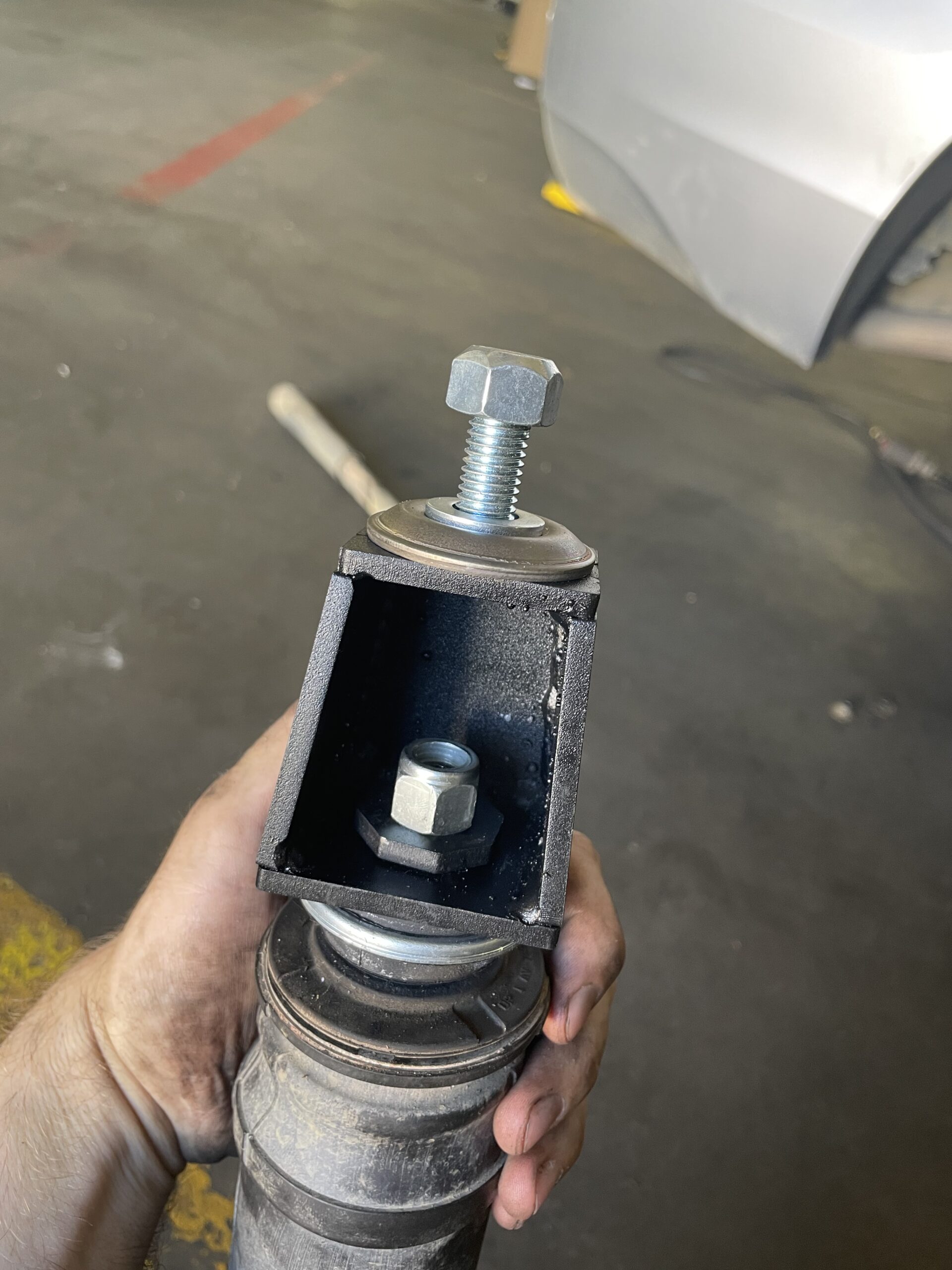
Method 1: Shock Mount Extension (Traxda)
- Spacer goes between the shock’s top mount and the chassis
- Moves the entire shock assembly down 2″
- Internally, the piston is still in the correct position within the shock body at ride height
- Control valves “see” the same position they were designed for
- Self-leveling system operates normally
Method 2: Shock Shaft Extension (Some Competitors)
- Extension piece added to the shock shaft itself
- Shock body stays in stock position
- The shaft extends 40mm+ further than designed
- At ride height, the piston now sits 40mm lower (more extended) inside the shock body than intended
Why Shaft Extensions Cause Problems
Here’s where the mechanical understanding becomes critical.
With a 40mm shaft extension installed:
- At what looks like proper ride height externally, the shock’s internal piston is sitting in the “already extended” zone
- The control valve is positioned past where it would normally activate pumping
- The Nivomat “thinks” the vehicle is already lifted
When you load the vehicle and it squats:
- Externally, the rear sits low and needs leveling
- But internally, the shock is still reading as “extended” or at best “neutral”
- The squat is invisible to the Nivomat – it started so far up in its stroke that the compression doesn’t register
- The pump never activates because it doesn’t detect the compression
- Result: permanent rear squat that never levels out
Real-World Evidence
Check Telluride and Palisade forums and you’ll find posts like:
- “Installed the lift kit with shaft extensions, rear still sits 1.5″ lower than front”
- “Had to add even thicker rear spacers on top of the shaft extensions to get it level”
- “Self-leveling doesn’t work anymore after the lift”
- “Dealer says they’re seeing lots of failed Nivomat shocks on lifted vehicles”
The shaft extensions aren’t defective – they’re just working against the fundamental design of the Nivomat system.
Why Mount Extensions Work
By moving the entire shock assembly down, the internal reference frame stays correct:
- At ride height: Piston is in the “neutral zone” = shock sees “proper height”
- Under load: Piston compresses into “pumping zone” = shock sees “need to lift”
- After driving: Pump activates, pressure builds, vehicle levels = system works as designed
The Nivomat’s mechanical “brain” continues to accurately read vehicle position because its internal calibration is preserved.
No Sensors to Relocate
Unlike GM, Ram, and other systems you might be familiar with, the Nivomat has:
- ✗ No electronic height sensors
- ✗ No air lines to extend
- ✗ No compressor wiring
- ✗ No external plumbing
It’s purely mechanical and self-contained. The only thing that matters is preserving the internal geometry.
How to Tell If You Have Self-Leveling Shocks
Palisade: Limited trim and SEL with Convenience Package
Telluride: Models with factory tow package
Part number for self-leveling shock: 55367-S9300
Part number for standard shock: 55307-S8100
Not sure? Look at the rear shocks – the self-leveling units are noticeably larger diameter.
The Right Solution
If you have a Palisade or Telluride with self-leveling shocks and want to lift it:
- Choose a kit that uses shock mount extensions, not shaft extensions
- Verify the kit is specifically designed for the Nivomat system
- Don’t assume “compatible with self-leveling” means it actually works properly – ask specifically how they handle the shock issue
At Traxda, we’ve been manufacturing lift kits since 2004 for dozens of vehicle platforms. Our engineering approach focuses on preserving factory systems rather than working around them. Our Palisade/Telluride kit (#801020) uses shock mount extensions that are laser-cut from USA Mill Certified Steel and welded in-house, specifically designed to preserve proper Nivomat operation.
Questions?
Understanding the mechanical principles behind your suspension helps you make informed decisions. If you have questions about your specific vehicle or need help determining which components you have, we’re here to help.
Shop Traxda Palisade/Telluride Lift Kit →